Research / Transport and mobility / WP6a
WP6a · Transport and mobility
Smart hubs and MaaS
In the project plan: Smart & safe mobility - smart hubs and mobility as a service
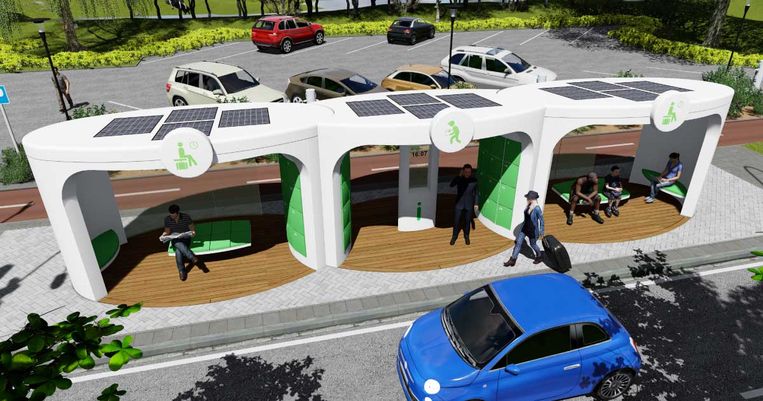
Mobility as a service (MaaS) bundles travel options into one personalised service; smart hubs bundle passenger and freight flows at shared locations. This work package set out to extend the Albatross activity-based mobility model with MaaS, smart hubs for last-mile freight and links to energy and climate models, and to work out where hubs should go and how pricing can steer travel towards cleaner choices.
✎ draftPrincipal investigators
Principal investigator · Eindhoven University of Technology Joost de Kruijf
Principal investigator · Breda University of Applied Sciences Leo Kemps
Co-investigator · Breda University of Applied Sciences
 Paul van de Coevering
Principal investigator · Breda University of Applied Sciences
 Soora Rasouli
Principal investigator · Eindhoven University of Technology
 Tom van Woensel
Principal investigator · Eindhoven University of Technology Virginie Lurkin
Principal investigator · Eindhoven University of Technology
PhD researchers


Other researchers
Principal investigator · Breda University of Applied Sciences Ellen Stoppels
Co-investigator · Breda University of Applied Sciences Seheon Kim
Co-investigator · Eindhoven University of Technology
- Virginie Lurkin, Professor
Partners









Also involved: European Supply Chain Forum, SWOV, De Verkeersonderneming
About this work package
**Objectives
**This WP aims at moving towards a more efficient and sustainable mobility system by combining travel
options into individually optimized multimodal services, ultimately tailored for each user and each trip
(MaaS). This WP will also explore how to use Smart Hubs in urban areas to facilitate last-mile
deliveries.
To deal with these complex problems of smart mobility, we plan to build on the Albatross activity-based
mobility model. NEON will extend Albatross to (1) encompass MaaS, (2) integrate freight transport
though the development of smart hubs, and (3) integrate energy and climate models.
These research efforts will achieve substantial efficiency gains by allowing stakeholders (customers and
operators) to cooperate and bundle passenger’s trips as well as freight on the last mile. A better
coordination between freight and passengers flows within an electric mobility (WP5) will lead to less
environmental pressure in cities. This will lead to new business models that better exploit the shared
existing infrastructure in space and time. With over a hundred publications and thousands of citations,
Albatross has a solid scientific basis. The main risk associated with this WP is to not have the relevant
data to calibrate the model. However, the involved parties have the needed experience, as well as the
required network to collect the relevant data and create their own case-studies.
Activities
- Calibrate the MaaS and Smart Hubs adoption models (econometric based model) with the Stated
preference (SP) data (M48) and determine which MaaS services (bundle configuration, pricing
scheme and price) should be offered to whom in order to maximize the adoption rate (M12). - Investigate the societal boundaries to multi-modal travel behaviour (M12).
- Define mobile smart hubs as a system, including the demand to be serviced, the type and number of
facilities used, the layout of the network and the transport modes supporting the operations of the
network (M12). - Calibrating daily use of MaaS and Smart Hubs (Probabilistic Decision Tree based model, Dynamic
Programming, Multi objective optimization algorithm) with revealed data combined with SP (M36) - Determine the optimum locations for the smart hubs within cities in light of forecasted demand
(M24). - Determine how mobile smart urban freight logistics hubs can be used dynamically in time and space
as flexible consolidation points in urban centres (M36). - Determine which fleet configuration is the best in each hub with respect to the demand of the users
(M43) - Research regulatory boundaries to the integration of multi-modal MaaS systems and smart hubs
(M24). - Determine how dynamic pricing can be employed to coordinate the use toward a more
environmentally friendly passenger and freight travel behaviour (M36). - Develop city logistic algorithms (freight and personal mobility) including the smart mobility concepts
(M36). - Model and simulate the location requirements of smart hubs in neighbourhoods (M36).
- Describe the administrative and business models adopted (M48).
- Implement the new model heuristics in the formalism of Albatross so it can drive smart mobility
behaviour in the integral model (M48).
Expected output
- At least 4 papers on MaaS
- At least 6 papers on Smart Hubs
- At least 4 papers on Smart Mobility
- Algorithms for the optimum locations of the smart hubs and optimum configuration of services
within each hub. - Algorithms to optimize locations of smart hubs including smart mobility concepts.
Text from the former NEON website (original page).
What the plan set out to do
Promises from the 2019 project plan, not results.
MaaS and smart hub adoption models calibrated with stated-preference and revealed-preference data.
Which MaaS bundles, pricing schemes and prices to offer to whom to maximise adoption.
A system definition of mobile smart hubs, optimal hub locations in cities and optimal fleet configuration per hub.
Dynamic pricing to steer passenger and freight travel towards cleaner behaviour; city logistics algorithms for freight and personal mobility.
Regulatory boundaries to multimodal MaaS and smart hubs; administrative and business models.
The new heuristics implemented in Albatross so that it drives smart mobility behaviour in the integral model (month 48).
At least 14 papers: 4 on MaaS, 6 on smart hubs, 4 on smart mobility.
Publications and talks
- Stochastic two-echelon vehicle routing with mobile satellites: Adaptive large neighborhood search with stochastic approximation scheduling (journal-article, 2026)
- Learning-Guided Adaptive Large Neighborhood Search for the Two-Echelon Vehicle Routing Problem with Mobile Satellites (report, 2026)
- Enhancing activity-based models: dynamic scheduling and trip chain modeling (phd-thesis, 2025)
- A two-echelon vehicle routing problem with mobile satellites and multiple commodities (journal-article, 2025)
- Accommodating (non-)monotonically changing hazards in finite mixture models for the inter-episode duration of discretionary activities (journal-article, 2025)
- Heterogeneity in inter-episode intervals for discretionary activities; covariate-dependent finite mixture models (journal-article, 2025)
- Multi-objective Optimal Trade-off Between V2G Activities and Battery Degradation in Electric Mobility-as-a-Service Systems (conference-paper, 2024)
- Accelerating the transition to sustainable energy and mobility (report, 2024)
- The Two-Echelon Time-Dependent Green Location-Routing Problem (report, 2024)
- How Shared Autonomous Electric Vehicles Could Slash Resource Use and Make Cities More Enjoyable (conference-paper, 2023)
- The implications of Mobility as a Service for urban emissions (journal-article, 2022)
- PhD defence: Enhancing activity-based models: dynamic scheduling and trip chain modeling (phd-defence, 2025-09-30)