People / Soora Rasouli
Principal investigator
Soora Rasouli
Professor | Urban planning & transportation
- Institution
- Eindhoven University of Technology
- Work packages
- In NEON
- 2020 onwards
- Now
- Full Professor and head of the Urban Planning and Transportation group, Department of the Built Environment, Eindhoven University of Technology.
Co-applicant in WP6a; promotor of Pim Labee and co-author of the joint WP4/WP6a vehicle-to-grid MaaS paper.
Expertise: Urban planning, travel behaviour, consumer demand modelling, activity-based models
Soora Rasouli is full professor in the Department of the Built Environment at Eindhoven University of Technology, where she leads the Urban Planning and Transportation group. Her research models travel behaviour and its response to new transport technologies such as electric and automated vehicles and mobility as a service, for use in planning and policy.
About me
My passion and love to learn is boundless. It does not only concern my professional discipline but many other aspects such as culture, history, art, sport and so on. From this perspective, being involved in a multi- disciplinary project during which I would have opportunity to be in contact with people of other disciplines, but still working on the same objective, is very tempting. We love fine food, delicate wine and travelling. We try to teach our kid to be aware of destructive emerging habit of (over-) consumption in the World. That the resources on the earth is limited and he can contribute to the well- being of other humans, far away from home, if he is conscious about amount of resources he consumes.

Personal Motivation
The responsibility of our generation is to set a clear roadmap for ourselves and the next generations to slow down and possibly stop the degradation of our earth, the only safe and familiar place for mankind to live. There have been zillions of research with the aim of shedding sufficient light on the right path ahead. What seems to be missing in those research and subsequently policy advices emerging from them is the lack of a holistic view. Social scientists discuss citizens behaviour and habits. While mechanical and electrical engineers concentrate their focus on the technological aspects. The interrelations between societal and technological aspects in an integrated framework is very rare. NEON has this potential.
Adoption and useage of innovative mobility options in activity-based models
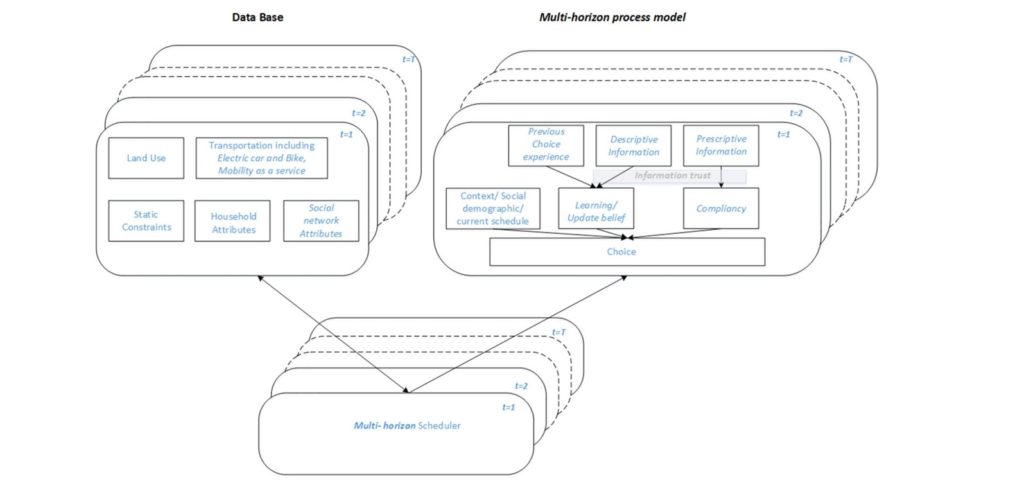
Investigation the willingness to adopt and use of innovative mobility options (EV, AV and MaaS) and integrating them into multi- horizon activity based model (MHABM) would be our contribution.
(MHABM) would allow us first to scale up the effect of innovation and technology (in transport modes) for the whole country and second would enable evaluating the effectiveness of various policy options for different population segments, various geographic areas in fine temporal and spatial granularity.
That is an individual based model which by definition empowers the analysts and policy makers to take into consideration the citizens reactions to planning and policies. MHABM can be linked to emission models to translate any policies into emission.
Link to other neon research
What had been missing in many previous studies regarding the future uptake and acceptance of mobility- related technology and their consequences for the society was the isolation of researchers in the mobility field from their peers in energy and technological domain. Such isolation would limit the comprehensiveness (and therefore the full effect) of the solutions proposed. For instance in our solution regarding the optimum location of EV- charging stations we incorporated citizens travel behavior (including charging behavior) and went for minimizing the distance and maximizing the coverage (of each charging station). The solution could be more effective if, for instance, the grid capacity (and temporal fluctuation) and likely future charging technology (for the speed of charging and battery capacity) would be considered as well. NEON has many related disciplines on board which would facilitate the collaboration
Profile text from the former NEON website.
✎ draftPhD researchers supervised

Publications and talks
- Accommodating (non-)monotonically changing hazards in finite mixture models for the inter-episode duration of discretionary activities (journal-article, 2025)
- Heterogeneity in inter-episode intervals for discretionary activities; covariate-dependent finite mixture models (journal-article, 2025)
- Multi-objective Optimal Trade-off Between V2G Activities and Battery Degradation in Electric Mobility-as-a-Service Systems (conference-paper, 2024)
- The implications of Mobility as a Service for urban emissions (journal-article, 2022)