Province transitions model
An integral transition model from NEON work package 10.
Neighborhood transition model
An integral transition model from NEON work package 10.
LUX-NL
The national model that grew out of NEON's integral modelling.
Models
Models
NEON Models
All of the NEON Models
Straight to solutions
Models to accelerate
Many PhD students are working on integral energy transition models. They combine technical, economic and social insights in relevant models, that have been proven in research and used in practice. This page highlights a selection of the models developed within the project.
The models
Neighborhood transition pathways
An interactive tool to help policy makers plan transition pathways in the built environment on a neighborhood level
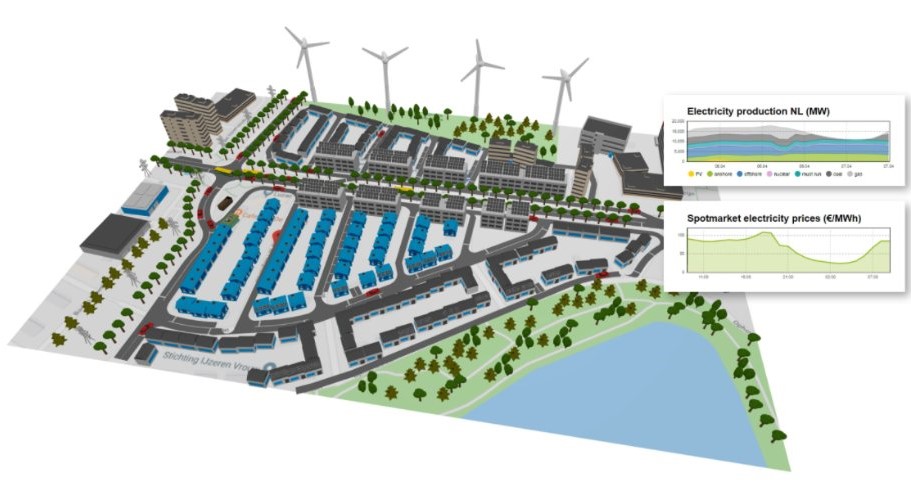
Neighborhood transitions model
The neighborhood transition model was used in a collaborative research approach to identify key trade-offs in local energy systems. The technological options include household insulation, EV, PV, district heating and (hybrid) heat pumps. Furthermore demand side management and home batteries are included for load balancing purposes.
The model was used in interactive sessions with policy makers and grid operators. The results of this are described in this paper.
Provincial energy system model
The provincial transition model was used in a collaborative research approach in combination with the neighborhood model. The provincial level was used to investigate the effects of choices in local heating systems on large scale infrastructure.
The model was used in interactive sessions with policy makers and grid operators. The results of this are described in this paper.
Provincial transition pathways
An interactive tool to help policy makers plan transition pathways in the built environment on a provincial level
Holon
An interactive tool to gain insight into the potential of local smart energy systems
Holon - local energy hubs
Holon is a research project towards local energy systems such as energy hubs and energy cooperatives. For the project a local energy system modelling framework was developed. The framework is used to model different local energy systems such as a business park, agricultural area, urban neighborhood, municipality, and industrial site. The model is focused on locally balancing supply and demand, working towards smart energy systems.
Furthermore, next to energy system models additional research was done to the legal status and organizational requirements of energy sharing, energy hubs, and other forms of local smart energy systems.
Text from the former NEON website (original page).