People / Theo Hofman

Principal investigator
Theo Hofman
Associate professor | Electric powertrain systems
- Institution
- Eindhoven University of Technology
- Work package
- In NEON
- 2020 onwards
- Now
- Full Professor, Department of Mechanical Engineering, Eindhoven University of Technology; programme director Automotive Systems.
Leader of WP4 (Electric cars and trucks). Promotor of Fabio Paparella and Maurizio Clemente, second promotor of Olaf Borsboom, and co-author/supervisor of Jorn van Kampen.
Expertise: Control systems technology, electric powertrain systems
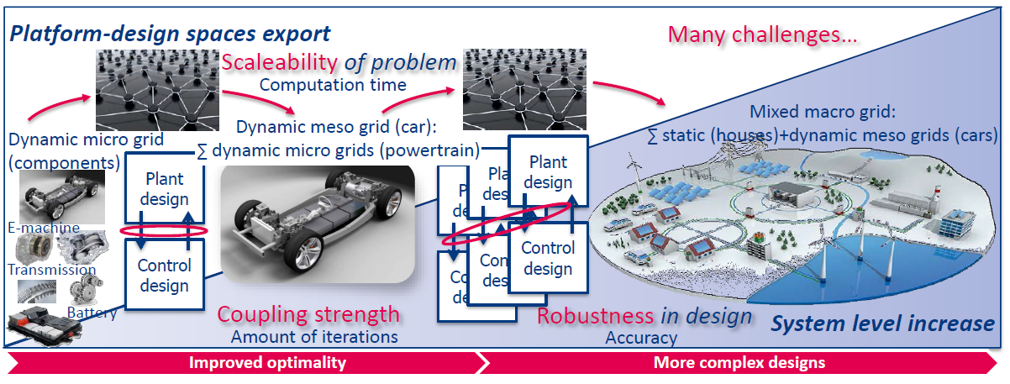
Theo Hofman is a full professor in the Mechanical Engineering department of Eindhoven University of Technology, where he leads a group in the Control Systems Technology section. His research develops integrated design methods for complex engineering systems, such as automated topology synthesis and combined plant and control design of electrified powertrains for road vehicles, ships and aircraft.
About me
As a researcher and mechanical engineer, I am always interested in the ‘why-question’. Especially, my interests are in multi-disciplinary and multi-domain research (mainly, in the field of automotive). I am intrigued by complex problems that require a systems’ approach and trade-offs in the design space. Within its limits you may have infinite options… The choice of leaving Eindhoven with my family about five years ago and moving to a very small village (“De glimlach van Brabant”, Dries van Agt) with much more space, a warm community and quiet nature nearby appeared to be a very good decision. We have two young daughters, a cat and three (very productive) chicken.
Personal Motivation
My focus is on automated system design for automotive powertrains: translating requirements, functions automatically into system architectures using platform-based design methods and performing integrated system design using model-based approaches: cost (€), energy (J), performance (km/h, m/s2, …), etc. Ultimately, for example, in the context of NEON, making customer-tailored electrified vehicle concepts for fleet owners better, cheaper and faster to manufacture. I hope that we can learn how to extract engineering knowledge in an automated fashion so we can synthesize – based on this knowledge – automatically new and novel vehicle system architectures. This requires a new systems-designing-systems paradigm.
E-Powertrain design for zero emission energy and mobility
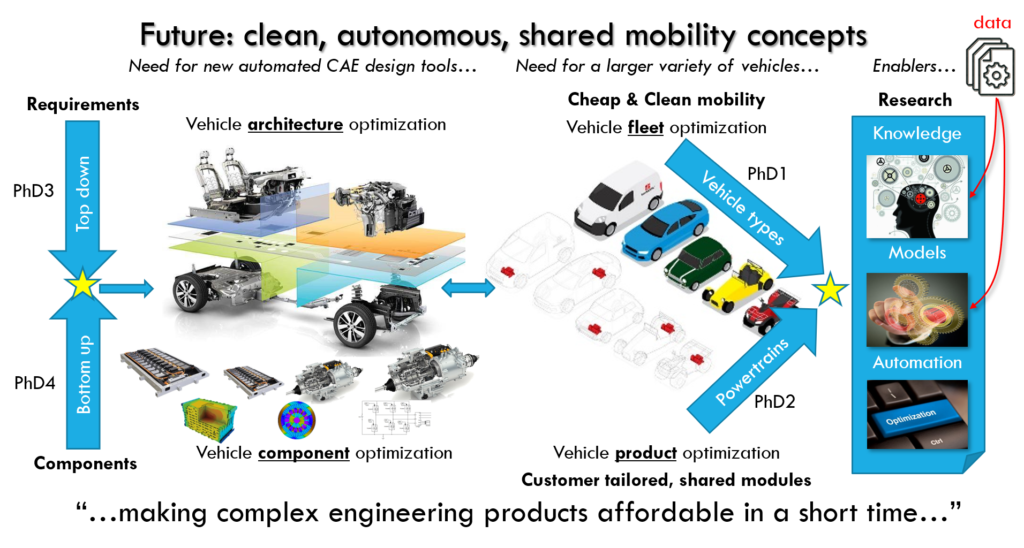
Vehicle fleet design optimization (PhD1): The automotive industry is in the middle of a turbulent shift from personally owned, gas powered cars to autonomous, shared, electric mobility solutions such as robot axis. This shift changes key assumptions in automotive design: usage cost becomes much more important and all the use cases that a single owned vehicle had to support can now be covered by a fleet of shared vehicles. Combined with digital manufacturing trends and faster development iterations this allows for more variety in fleets, with vehicles that are more optimized for a smaller set of use cases and hence exhibit lower operational costs. Based on the mobility demand of a region (e.g. The Netherlands) an ideal fleet composition of different, optimized vehicles can be determined. Therefore, it is necessary to accurately model the user demand, to be able to evaluate the convenience of the fleet for the user. Furthermore, it is necessary to develop accurate, parametric cost models for the development, production and use of vehicles with shared components. These models are then to be used to run a joint optimization to determine the specifications and relative share of the variants in the fleet.
Customer-tailored Product Family Design for Multiple Electric Vehicle Fleet Applications (PhD2): The automotive industry has generally focused on a platform strategy to minimize development and production costs and maximize the reuse of components in different vehicles. More variety in fleets due to the above trends calls for a re-evaluation of this strategy, where the component reuse is optimized for the total lifetime costs of the fleet instead of for the purchase cost, considering lifetime energy consumption, repair & maintenance and second life. The key performance indicators of the product family can be measured by jointly optimizing the sizing and the operation of the components for the whole family. To this end, it is important to devise mathematical models capturing the impact of the single components on the performance of the product family with adequate accuracy and in a computationally tractable fashion. The goal of this research is to devise computer-aided design tools to optimize the design of a modular platform (set of components or subsystems) for a product family of (solar) e-vehicles.
Architecture Design for Multiple Electric Vehicle Products (PhD3): Current optimization techniques often focus on the component level, while the biggest impact is often to be found on the systems’ level. The systems engineering process used in industry to derive architectures is often tedious and informal, resulting in suboptimal architectures. Formalizing and partially automating part of the concept design phase to enable fast creation and evaluation of architectures can lead to more optimal system architectures for vehicles. In this context, the topology of a system, namely the choice, placement and interconnection of its components, has a significant impact on its achievable performance and must be carefully studied. Therefore, the possibility to rapidly generate automatically optimized system architectures from a set of desired functionalities and a library of component technologies (platform) would ultimately greatly accelerate the deployment of electric vehicles and lead to better performance on the cost function (typically total-cost-of-ownership). The key questions relate to how to automatically extract engineering knowledge that supports the top-down design process by understanding which subsystems or components from the platform fulfil certain system-level functional requirements and how to connect them by formulating mathematical constraints as in a bottom-up design process. This research aims at devising discrete mathematical models and optimization models and methods for system-level powertrain design.
Multi-fidelity Modeling Methods for Electric Powertrain System Design (PhD4): The achievable performance of a topology-technology solution can be measured by jointly optimizing the sizing and the operation of its components. To this end, co-design at powertrain system design level is important to devise mathematical models capturing the impact of sizing choices on the components’ performance with adequate accuracy and in a computationally tractable fashion, using different heterogeneous models at different levels of aggregation. The research aims at devising computationally tractable optimization models for powertrain system design.
Link to other neon research
There are different “links” to the different WPs. In particular information to receive about real world cases, data to model our components (efficiency, cost, life cycle), vehicles in different usage conditions (geographically), yet we also to expect to obtain relevant data via our own WP partners Lightyear, TNO.
Profile text from the former NEON website.
✎ draftPhD researchers supervised




Publications and talks
- A Decomposition-Based Framework for Joint Optimization and Spatial Packaging of Interconnected Systems with Physical Interactions (report, 2026)
- Geometric Scaling of Battery Cells and Its Effect on Key Performance Indicators (report, 2026)
- Automated Three-Dimensional Spatial Optimization for Multidomain Systems With Alignment Constraints (journal-article, 2025)
- Concurrent design optimization of powertrain component modules in a family of electric vehicles (journal-article, 2025)
- Design Optimization of Electric Vehicle Drivetrains Using Surrogate Modeling Frameworks (journal-article, 2025)
- Meta-analysis of life cycle assessments for Li-ion batteries production emissions (journal-article, 2025)
- Two-wheel-driven Electric Superbike Powertrain Optimization (conference-paper, 2025)
- A Time-invariant Network Flow Model for Ride-pooling in Mobility-on-Demand Systems (journal-article, 2024)
- Electric Autonomous Mobility-on-Demand: Jointly Optimal Vehicle Design and Fleet Operation (journal-article, 2024)
- Optimal Endurance Race Strategies for a Fully Electric Race Car Under Thermal Constraints (journal-article, 2024)
- Ride-pooling Electric Autonomous Mobility-on-Demand: Joint optimization of operations and fleet and infrastructure design (journal-article, 2024)
- A Framework to Estimate Life Cycle Emissions for Vehicle-Integrated Photovoltaic Systems (conference-paper, 2024)
- A Geometric Electric Motor Model for Optimal Vehicle Family Design (conference-paper, 2024)
- A Time-Invariant Network Flow Model for Two-Person Ride-Pooling Mobility-on-Demand (conference-paper, 2024)
- A Two-dimensional Spatial Optimization Framework for Vehicle Powertrain Systems (conference-paper, 2024)
- Automated Design Optimization of Axial and Radial Flux Motors for E-powertrains (conference-paper, 2024)
- Congestion-Aware Ride-Pooling in Mixed Traffic for Autonomous Mobility-on-Demand Systems (conference-paper, 2024)
- Effective Scaling of High-Fidelity Electric Motor Models for Electric Powertrain Design Optimization (conference-paper, 2024)
- Exploring Electric Vehicle Market Dynamics with Agent-Based Modelling: The Impact of Design Strategies and Consumer Characteristics (conference-paper, 2024)
- Geometric Scaling Laws for Axial Flux Permanent Magnet Motors in In-Wheel Powertrain Topologies (conference-paper, 2024)
- Multi-layer optimisation of hybrid energy storage systems for electric vehicles (conference-paper, 2024)
- Multi-objective Optimal Trade-off Between V2G Activities and Battery Degradation in Electric Mobility-as-a-Service Systems (conference-paper, 2024)
- System-level thermal and electrical modeling of battery systems for electric aircraft design (conference-paper, 2024)
- Ride-Pooling Autonomous Mobility-on-Demand in Mixed Traffic Conditions (report, 2024)
- Cost-optimal Fleet Management Strategies for Solar-electric Autonomous Mobility-on-Demand Systems (conference-paper, 2023)
- Electric Mobility Design: From Powertrain Components to Vehicle Fleet Optimization (conference-paper, 2023)
- Optimization-Based Comparison of Rebalanced Docked and Dockless Micromobility Systems (conference-paper, 2023)
- Transmission Design and Control Optimization of an Electric Vehicle Using Analytical Modeling Methods (conference-paper, 2023)
- Concurrent Powertrain Design for a Family of Electric Vehicles (conference-paper, 2022)
- Electric Autonomous Mobility-on-Demand: Joint Optimization of Routing and Charging Infrastructure Siting (conference-paper, 2022)
- Electric Motor Design Optimization: A Convex Surrogate Modeling Approach (conference-paper, 2022)
- Energy-optimal Design and Control of Electric Powertrains under Motor Thermal Constraints (conference-paper, 2022)
- Joint Optimization of Number of Vehicles, Battery Capacity and Operations of an Electric Autonomous Mobility-on-Demand Fleet (conference-paper, 2022)
- A Convex Optimization Framework for Minimum Lap Time Design and Control of Electric Race Cars (journal-article, 2021)
- Optimal Design of Electric Micromobility Vehicles (conference-paper, 2021)
- Time-optimal Control of Electric Race Cars under Thermal Constraints (conference-paper, 2021)
- Time-optimal Control Strategies for Electric Race Cars with Different Transmission Technologies (conference-paper, 2020)