People / Mauro Salazar
Co-investigator
Mauro Salazar
Assistant professor | Electric cars and trucks
- Institution
- Eindhoven University of Technology
- Work package
- Now
- Associate Professor, Control Systems Technology section, Department of Mechanical Engineering, Eindhoven University of Technology; leads the MOVEMENT research group.
Co-PI in WP4. Co-promotor of Fabio Paparella, promotor of Olaf Borsboom (first) and Maurizio Clemente (second), and supervisor/co-author of Jorn van Kampen.
Mauro Salazar is an associate professor in the Control Systems Technology section at Eindhoven University of Technology, where he leads the MOVEMENT research group. His research combines optimization and control to design and operate sustainable and fair mobility and energy systems, from single vehicles to whole transport networks.
About me
I just moved to the Netherlands, the country of Spinoza, of the Flemish masters of light, of Jheronimus Bosch, of humanism and innovation, to follow my academic dream by joining Eindhoven University of Technology. I am thrilled to be here and I am looking forward to a fruitful and adventurous period. I concur with what Francesco De Sanctis used to say to engineering students during his Italian literature lectures: “Before being engineers, you are first and foremost humans”. Now more than ever we need a holistic perspective on innovation and education, and carry out research that is not done for the sake of research but for the sake of a sustainable, inclusive and happy future for the planet and future generations.
Personal Motivation
I am enthusiastic about humanism, creativity, technology and science. My research mission is to make mobility more sustainable and inclusive, and—in line with our responsibility as engineers and human beings—to ultimately make the world a better place. NEON is the right framework to contribute to a sustainable society with the power of humanism, creativity, technology and science. I consider it extremely important and fascinating to work at problems that are both technically challenging and societally relevant.
E-Powertrain design for zero emission energy and mobility
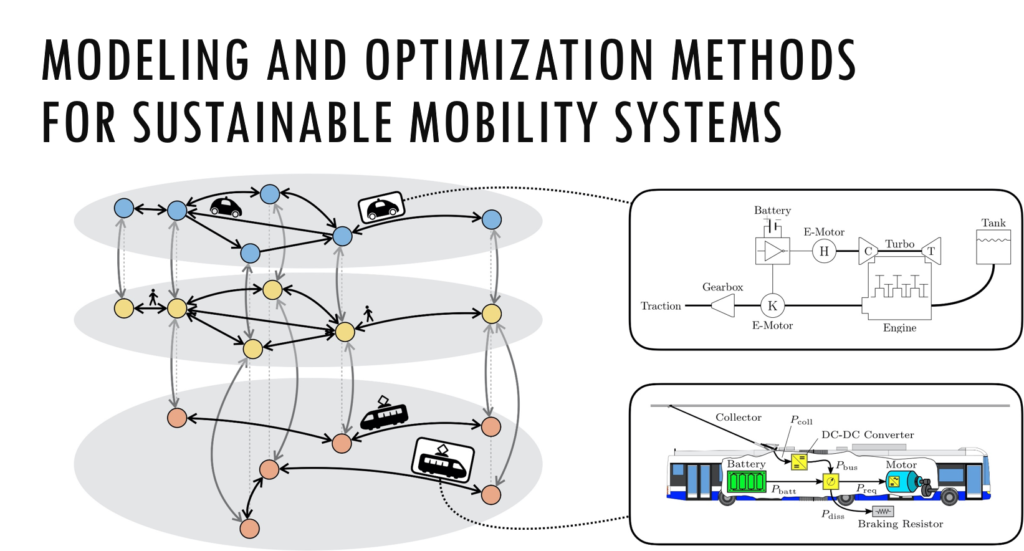
My research is at the interface of control theory and optimization, and is aimed at enabling the deployment of sustainable solutions for current and future mobility systems, from the single-vehicle level up to the transportation-system level.
Within NEON, I will leverage and combine modeling and optimization methods to frame and solve optimal design and operational problems with applications ranging from single vehicles and powertrains to entire transportation systems.

Link to other neon research
There are different links to the other WPs. In particular, we expect to receive information about real world cases, data to model our components (efficiency, cost, life cycle), mobility demand distributions and different vehicles’ usage conditions. Furthermore, we also expect to obtain relevant data from our own WP partners Lightyear and TNO.
Profile text from the former NEON website.
✎ draftPhD researchers supervised


Publications and talks
- Competitor-aware Race Management for Electric Endurance Racing (report, 2026)
- Automated Three-Dimensional Spatial Optimization for Multidomain Systems With Alignment Constraints (journal-article, 2025)
- Concurrent design optimization of powertrain component modules in a family of electric vehicles (journal-article, 2025)
- Design Optimization of Electric Vehicle Drivetrains Using Surrogate Modeling Frameworks (journal-article, 2025)
- Human-in-the-loop energy and thermal management for electric racing cars through optimization-based control (journal-article, 2025)
- Meta-analysis of life cycle assessments for Li-ion batteries production emissions (journal-article, 2025)
- Mobilizing transport justice: a sufficientarian optimization framework for intermodal mobility systems (journal-article, 2025)
- Analysis of Nash and Stackelberg Equilibria of Autonomous Mobility-on-Demand Systems in Mixed Traffic (conference-paper, 2025)
- Two-dimensional Spatial Optimization for Electric Motorcycle Powertrain Elements using Mixed-integer Programming (report, 2025)
- A Time-invariant Network Flow Model for Ride-pooling in Mobility-on-Demand Systems (journal-article, 2024)
- Electric Autonomous Mobility-on-Demand: Jointly Optimal Vehicle Design and Fleet Operation (journal-article, 2024)
- Joint Fuel-Optimal Control of the Velocity and Power-Split of Hybrid Electric Vehicles (journal-article, 2024)
- Model Predictive Control Strategies for Electric Endurance Race Cars Accounting for Competitors’ Interactions (journal-article, 2024)
- Optimal Endurance Race Strategies for a Fully Electric Race Car Under Thermal Constraints (journal-article, 2024)
- Ride-pooling Electric Autonomous Mobility-on-Demand: Joint optimization of operations and fleet and infrastructure design (journal-article, 2024)
- A Framework to Estimate Life Cycle Emissions for Vehicle-Integrated Photovoltaic Systems (conference-paper, 2024)
- A Geometric Electric Motor Model for Optimal Vehicle Family Design (conference-paper, 2024)
- A Time-Invariant Network Flow Model for Two-Person Ride-Pooling Mobility-on-Demand (conference-paper, 2024)
- A Two-dimensional Spatial Optimization Framework for Vehicle Powertrain Systems (conference-paper, 2024)
- Congestion-Aware Ride-Pooling in Mixed Traffic for Autonomous Mobility-on-Demand Systems (conference-paper, 2024)
- Effective Scaling of High-Fidelity Electric Motor Models for Electric Powertrain Design Optimization (conference-paper, 2024)
- Exploring Electric Vehicle Market Dynamics with Agent-Based Modelling: The Impact of Design Strategies and Consumer Characteristics (conference-paper, 2024)
- Geometric Scaling Laws for Axial Flux Permanent Magnet Motors in In-Wheel Powertrain Topologies (conference-paper, 2024)
- Multi-objective Optimal Trade-off Between V2G Activities and Battery Degradation in Electric Mobility-as-a-Service Systems (conference-paper, 2024)
- On Accessibility Fairness in Intermodal Autonomous Mobility-on-Demand Systems (conference-paper, 2024)
- A Human-optimized Model Predictive Control Scheme and Extremum Seeking Parameter Estimator for Slip Control of Electric Race Cars (report, 2024)
- Ride-Pooling Autonomous Mobility-on-Demand in Mixed Traffic Conditions (report, 2024)
- Cost-optimal Fleet Management Strategies for Solar-electric Autonomous Mobility-on-Demand Systems (conference-paper, 2023)
- Optimization-Based Comparison of Rebalanced Docked and Dockless Micromobility Systems (conference-paper, 2023)
- Transmission Design and Control Optimization of an Electric Vehicle Using Analytical Modeling Methods (conference-paper, 2023)
- Maximum-distance race strategies for a fully electric endurance race car (journal-article, 2022)
- Concurrent Powertrain Design for a Family of Electric Vehicles (conference-paper, 2022)
- Electric Autonomous Mobility-on-Demand: Joint Optimization of Routing and Charging Infrastructure Siting (conference-paper, 2022)
- Electric Motor Design Optimization: A Convex Surrogate Modeling Approach (conference-paper, 2022)
- Energy-optimal Design and Control of Electric Powertrains under Motor Thermal Constraints (conference-paper, 2022)
- Joint Optimization of Number of Vehicles, Battery Capacity and Operations of an Electric Autonomous Mobility-on-Demand Fleet (conference-paper, 2022)
- Minimum-lap-time Control Strategies for All-wheel Drive Electric Race Cars via Convex Optimization (conference-paper, 2022)
- A Convex Optimization Framework for Minimum Lap Time Design and Control of Electric Race Cars (journal-article, 2021)
- Optimal Design of Electric Micromobility Vehicles (conference-paper, 2021)
- Time-optimal Control of Electric Race Cars under Thermal Constraints (conference-paper, 2021)
- Time-optimal Control Strategies for Electric Race Cars with Different Transmission Technologies (conference-paper, 2020)